

At MedKoder, we believe coding technology should work the way coders think.
That’s why we’re excited to announce a major enhancement to the Index Term Search functionality within MedKoder’s Risk Adjustment Encoder: a newly refined search algorithm designed to deliver more robust, precise and clinically relevant results.
This enhancement improves how users navigate ICD-10-CM index terms by streamlining result prioritization and reducing unnecessary noise, helping coding professionals reach the right coding pathways faster and with greater confidence.
What Changed?
Our previous search experience returned broader result sets that often required users to manually navigate through multiple unrelated pathways before locating the most relevant clinical relationship.
The new algorithm intelligently refines and prioritizes results based on:
- Clinical specificity
- Relevant coding relationships
- Search intent matching
- Improved hierarchy recognition
- Reduced irrelevant result expansion
The result is a cleaner, more focused coding experience that surfaces the most applicable pathways first.
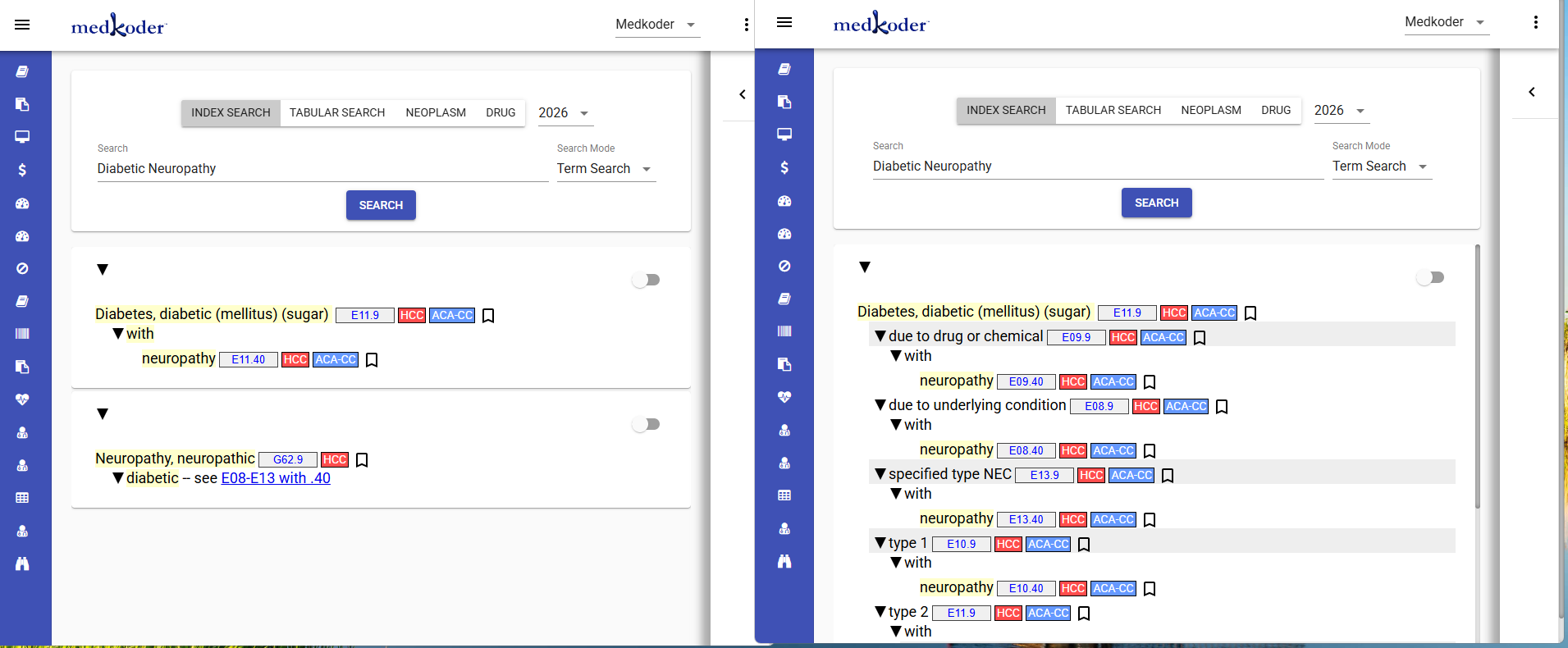
Example 1: Diabetic Neuropathy
In the previous algorithm (right), users were presented with a large number of diabetes-related pathways, including multiple etiologies and unspecified condition branches. While comprehensive, the result set could require additional navigation to identify the most appropriate diabetic neuropathy relationship.
With the new algorithm implementation (left), the search results are significantly more refined. The most relevant diabetic neuropathy pathway is surfaced immediately, allowing coders to identify the appropriate coding direction faster and with less visual clutter.
Key Improvement
The enhanced algorithm prioritizes the clinically relevant “with neuropathy” relationship instead of overwhelming users with extensive unrelated branches.
Example 2: Moderate Dementia
The improvements are equally visible in dementia-related searches.
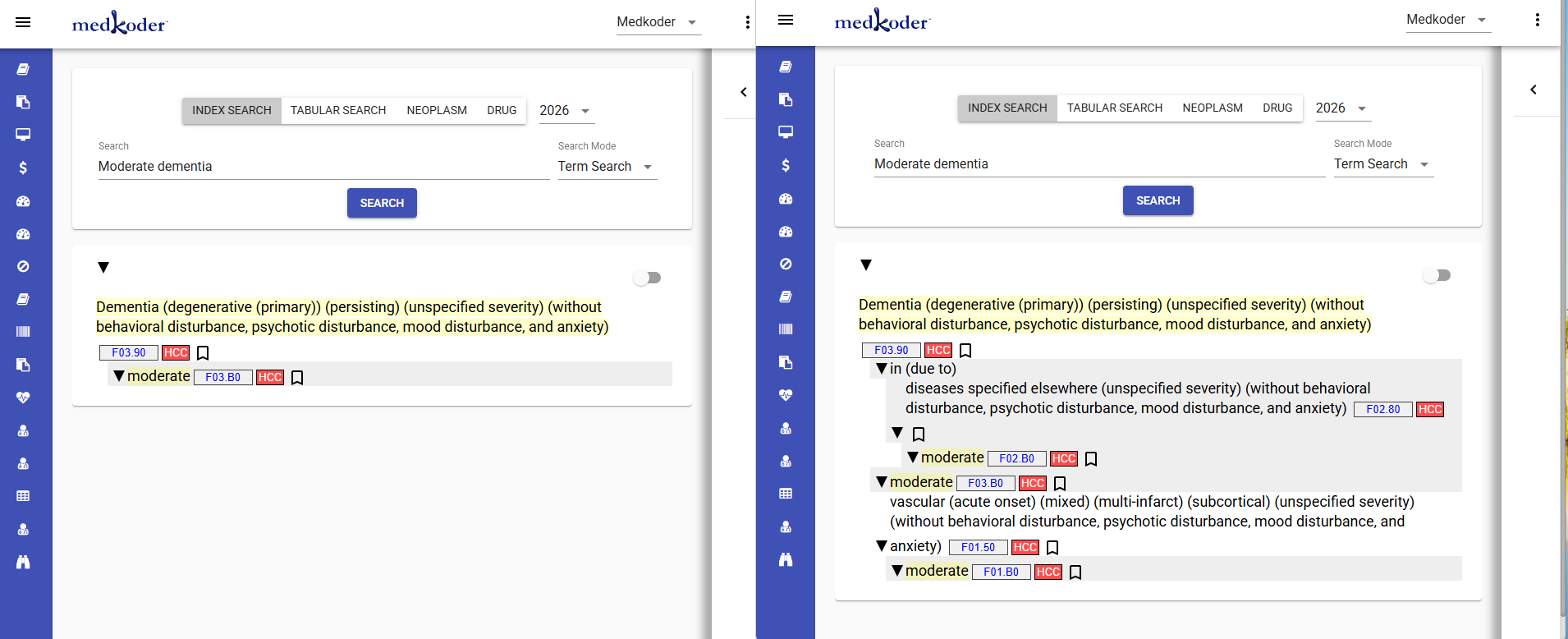
Under the previous algorithm (right), users received multiple dementia categories and severity pathways simultaneously, including broader disease-associated and vascular dementia branches that may not align with the immediate search intent.
With the updated search algorithm (left), the system more effectively isolates the intended “moderate dementia” relationship, providing a streamlined and focused result set.
Key Improvement
The new logic reduces unnecessary branching and elevates the most actionable coding relationship earlier in the workflow.
Why This Matters for Risk Adjustment Coding
Risk adjustment coding depends on speed, specificity and defensibility. Search inefficiencies can slow workflows, increase cognitive burden and create opportunities for missed specificity.
This enhancement helps coding teams:
- Reduce search friction
- Improve coding efficiency
- Navigate ICD-10-CM relationships more intuitively
- Minimize time spent expanding unnecessary pathways
- Increase confidence in code selection workflows
By aligning search behavior more closely with real-world coding logic, the Risk Adjustment Encoder continues to evolve into a stronger coding decision support platform...not just a code lookup tool.
Built for Coders
The enhanced Index Term Search algorithm reflects MedKoder’s ongoing commitment to developing coder-centric technology solutions that prioritize usability, transparency and coding accuracy.
As coding complexity continues to increase, intelligent search refinement becomes essential, not optional.
This release is another step toward helping coding professionals move from searching for answers to confidently validating decisions.
Experience the Difference
The enhanced Index Term Search functionality is now available within MedKoder’s Risk Adjustment Encoder.
To learn more about the platform, request a demo or get started today.